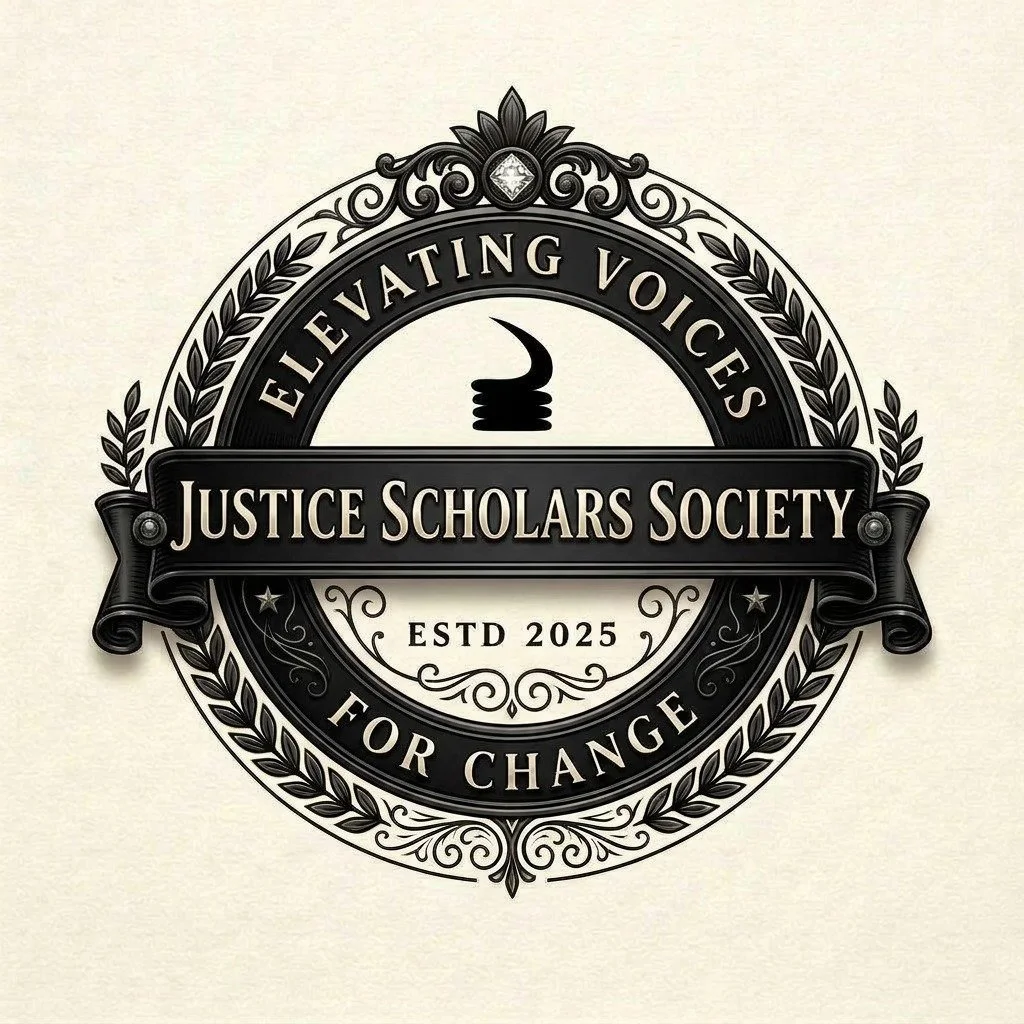
The Justice Scholars Society Seal
Meaning, Symbolism, and Institutional Identity
The Justice Scholars Society (JSS) Seal is the official visual expression of the Society’s intellectual identity, moral commitments, institutional purpose, and responsibility to future generations. Established in 2025, the Justice Scholars Society exists to cultivate scholarship that does more than interpret the world: it seeks to form conscience, pursue justice, develop consequential leadership, and preserve intellectual and moral resources capable of serving generations yet to come.
The seal should therefore be understood as more than an organizational logo. It is an institutional covenant rendered symbolically. Every major element communicates an aspect of the Society’s philosophy: knowledge must be pursued with integrity; formation must accompany education; justice must remain attentive to human dignity; leadership must strengthen communities and institutions; and scholarship must ultimately serve purposes greater than the scholar.
At the center of the seal are four interconnected pillars: Scholarship, Formation, Justice, and Leadership. Surrounding them are symbols of truth, continuity, wisdom, public responsibility, global engagement, and generational stewardship. Together they express the distinctive vocation of Justice Scholars Society.
The Four Pillars
I. Scholarship — Seek Truth. Expand Knowledge.
The open book represents disciplined inquiry, research, intellectual freedom, education, and the preservation and expansion of knowledge.
For JSS, scholarship is not merely the accumulation of information. Scholarship requires disciplined investigation, methodological rigor, critical reflection, intellectual humility, and a willingness to submit ideas to examination. The scholar bears a responsibility both to discover what is true and to communicate that truth responsibly.
The illuminated star above the book signifies intellectual illumination: the moment when careful inquiry enables previously obscured realities to become visible. It represents discovery, insight, and the conviction that scholarship should expand the boundaries of human understanding.
The first pillar therefore establishes the intellectual mandate of JSS:
Seek Truth. Expand Knowledge.
JSS scholarship should not merely repeat inherited assumptions. It should interrogate them, test them, refine them, and, when necessary, challenge them.
II. Formation — Cultivate Character. Shape Conscience.
The burning torch represents formation, enlightenment, moral courage, intellectual transmission, and the responsibility to carry knowledge forward.
Education without formation can produce technically sophisticated individuals without the moral capacity to use knowledge responsibly. Justice Scholars Society therefore distinguishes between simply informing the mind and forming the person.
Formation asks deeper questions:
What kind of person is scholarship producing?
What moral responsibilities accompany knowledge?
How is conscience cultivated?
How should intellectual power be exercised?
The flame symbolizes knowledge that has become morally alive. It represents the transmission of wisdom from one generation to another and the continuing responsibility of scholars, clergy, educators, leaders, and institutions to cultivate persons capable of exercising judgment, courage, discernment, and ethical responsibility.
Thus the second pillar declares:
Cultivate Character. Shape Conscience.
JSS understands scholarship and formation as inseparable. Knowledge becomes most consequential when intellectual development is accompanied by moral development.
III. Justice — Pursue Dignity. Defend the Oppressed.
The scales of justice represent moral accountability, fairness, human dignity, ethical judgment, and the continuing struggle against structures that diminish human flourishing.
Justice within JSS is not understood merely as an abstract philosophical category. It is a public and institutional responsibility.
The scales remind scholars and leaders that societies, institutions, policies, traditions, and systems must continually be weighed against the demands of dignity and justice. They also symbolize the responsibility to examine disparities of power and to recognize those whose voices, experiences, or suffering may otherwise remain outside dominant systems of attention.
The JSS commitment to justice therefore requires both moral attention and structural analysis. Scholarship must be capable of identifying injustice, understanding the mechanisms that sustain it, amplifying neglected knowledge, and contributing toward meaningful forms of repair.
The third pillar consequently commands:
Pursue Dignity. Defend the Oppressed.
Justice is not peripheral to the scholarly vocation of JSS. It is one of the standards by which scholarship, leadership, and institutional legitimacy must ultimately be evaluated.
IV. Leadership — Build Community. Transform Systems.
The bridge represents leadership as connection, institution-building, public responsibility, and movement between what presently exists and what might yet become possible.
A bridge joins communities that would otherwise remain separated. It carries people across obstacles. It creates pathways where barriers previously existed.
For Justice Scholars Society, leadership is therefore not defined principally by position, title, prestige, or institutional rank. Leadership is measured by the capacity to build durable relationships, strengthen communities, cultivate institutions, expand opportunity, and transform systems.
The bridge also represents JSS's commitment to crossing traditional boundaries: between academy and community, scholarship and practice, faith and public life, historical memory and contemporary inquiry, intellectual theory and institutional transformation.
The fourth pillar states:
Build Community. Transform Systems.
Leadership worthy of JSS must ultimately leave institutions, communities, and future generations stronger than it found them.
The Central Semicolon
At the precise intersection of the four pillars stands one of the seal's most distinctive symbols: the semicolon.
The semicolon represents continuation without erasure.
Grammatically, a semicolon appears where a sentence could have ended but continues. Within the intellectual and moral architecture of Justice Scholars Society, it therefore represents endurance, unfinished work, historical continuity, and the refusal to accept premature endings.
The semicolon declares that injustice does not possess the authority to write the final sentence of human possibility.
It recognizes that scholarship is unfinished; justice is unfinished; democracy is unfinished; formation is unfinished; institutional transformation is unfinished.
Its central placement is intentional. Scholarship, formation, justice, and leadership converge around the responsibility to continue the work.
The semicolon therefore functions as a symbol of disciplined continuation: honoring what has been inherited while creating intellectual and institutional possibilities for what must come next.
Around the semicolon appear the Latin words:
VERITAS LIBERAT — VERITAS SERVAT
Truth Liberates — Truth Preserves.
Together these principles establish a dual responsibility of scholarship. Truth must possess the courage to liberatepeople from ignorance, distortion, injustice, and inherited falsehood. Yet truth must also preserve wisdom, memory, dignity, institutional knowledge, and the intellectual inheritance required by future generations.
Truth must challenge.
Truth must also conserve what deserves to endure.
The Tree and Radiating Light
Above the shield stands a deeply rooted tree surrounded by radiating light.
The tree represents intellectual lineage, institutional rootedness, wisdom, growth, continuity, and generational inheritance. Its visible roots remind JSS that serious scholarship never emerges from nowhere. Every scholar inherits languages, traditions, histories, struggles, mentors, communities, and bodies of knowledge that precede them.
Its branches point toward growth and possibility.
The surrounding rays signify the expanding influence of knowledge and moral imagination. What begins in disciplined scholarship can radiate outward into classrooms, congregations, communities, institutions, public policy, democratic life, and future intellectual traditions.
The tree therefore expresses an important JSS principle:
Deep roots make expansive intellectual growth possible.
The Laurel Branches
The laurel branches surrounding the central shield represent scholarly achievement, honor, disciplined excellence, and distinction.
Historically associated with learning and accomplishment, the laurels acknowledge excellence without allowing achievement to become self-glorification.
Within JSS, distinction carries responsibility.
Recognition should increase service.
Knowledge should increase accountability.
Achievement should increase one's obligation to others.
The laurels therefore honor intellectual excellence while placing that excellence inside a larger moral vocation.
The Four Governing Values
Inscribed along the right side of the seal are four governing values:
TRUTH
DIGNITY
JUSTICE
LEGACY
These words provide an ethical sequence for the Society.
Truth establishes the intellectual foundation. Scholarship begins with disciplined attention to reality.
Dignity establishes the human foundation. Knowledge must never lose sight of the inherent worth of persons and communities.
Justice establishes the public obligation. Truth and dignity must become consequential within institutions, systems, and social relationships.
Legacy establishes the temporal horizon. The consequences of scholarship and leadership extend beyond the present generation.
Together they form a moral progression:
Truth informs dignity.
Dignity demands justice.
Justice creates legacy.
EST. 2025
The inscription EST. 2025 identifies the founding year of Justice Scholars Society.
Its presence carries meaning beyond chronology. It marks the beginning of an institution consciously designed to think generationally from its inception.
JSS does not measure institutional significance merely by age. Institutions become consequential through the integrity of their scholarship, the rigor of their methods, the quality of the people they form, the traditions they establish, and the intellectual inheritance they leave behind.
2025 therefore represents a beginning rather than a completion.
The Global Compass
At the base of the shield rests a globe and compass.
The globe represents the international and interdisciplinary horizon of scholarship. Justice, dignity, leadership, democracy, religion, technology, education, institutional life, and human flourishing cannot be understood exclusively within one geographical or disciplinary boundary.
The compass represents orientation.
Knowledge provides information; wisdom provides direction.
The scholar must therefore ask not simply:
What can we know?
but also:
Where should this knowledge lead us?
The compass expresses the JSS commitment to scholarship capable of providing moral and institutional orientation in periods of complexity, disruption, and change.
Non Sibi, Sed Futuris
Across the lower center of the seal appears the Society's generational declaration:
NON SIBI, SED FUTURIS
Not for Self, but for Future Generations.
This phrase provides the interpretive key to the entire seal.
Scholarship is not ultimately undertaken for personal recognition.
Leadership is not ultimately exercised for status.
Institutions are not ultimately built for their founders.
Knowledge is not ultimately accumulated for possession.
The work must outlive the worker.
Non Sibi, Sed Futuris expresses the Society's commitment to generational stewardship: the conviction that scholars and institutions inherit responsibilities from those who came before them and incur obligations toward people they may never meet.
Every article written, framework developed, scholar formed, institution strengthened, injustice confronted, archive preserved, and intellectual tradition established should contribute something to a future beyond the present generation.
This is the generational ethic of Justice Scholars Society.
Encircling the foundation of the seal is the public declaration of Justice Scholars Society:
ELEVATING VOICES FOR CHANGE
The phrase defines how JSS enters the public sphere.
To elevate voices is not simply to provide visibility. It means creating intellectual and institutional conditions in which serious ideas, neglected perspectives, emerging scholars, community knowledge, and morally consequential research can receive sustained attention.
The phrase also establishes an important distinction.
JSS does not elevate voices merely so they may be heard.
It elevates voices so that knowledge may become consequential.
The ultimate objective is change: changes in understanding, conscience, scholarship, leadership, institutions, public discourse, and systems.
The Seal as Institutional Covenant
Taken as a whole, the Justice Scholars Society Seal presents a coherent philosophy of intellectual life.
Scholarship asks what is true.
Formation asks what kind of people we must become.
Justice asks what dignity requires.
Leadership asks what we must build and transform.
The semicolon reminds us that the work continues.
The tree reminds us that we are rooted in traditions larger than ourselves.
The laurels call us toward disciplined excellence.
The scales demand accountability.
The bridge calls us beyond intellectual isolation toward institutional transformation.
The torch requires knowledge to be transmitted.
The book requires knowledge to be pursued.
The compass demands moral direction.
And Non Sibi, Sed Futuris reminds us why the entire enterprise exists:
Not for self, but for future generations.
The Justice Scholars Society Seal therefore represents more than institutional identity. It articulates an intellectual vocation and a public promise:
To seek truth rigorously, form conscience intentionally, pursue justice courageously, build institutions responsibly, preserve what must not be forgotten, challenge what must not remain unchanged, and leave future generations an intellectual and moral inheritance greater than the one we received.
That is the covenant represented by the seal of the Justice Scholars Society.